🗓️
2025
Markets in Motion
🧭 Context turns noise into signal

I used to get whiplash from financial headlines.
Every day brought a new panic — inflation, recession, geopolitical shocks. I’d find myself reacting to each one as if it were brand new.
Over time, I started to feel there had to be a bigger framework — some way to connect all these moving parts into a single, coherent story. The business cycle and the liquidity cycle couldn’t just be random — they had to be related.
That search is what led me to Raoul Pal’s Everything Code Dominoes — a framework that changed how I see the business cycle and the flow of liquidity behind it. It made me realize most “breaking news” is just the echo of something that happened months earlier.
Once you understand where we are in the sequence, the noise turns into signal.
Understanding the Cycle
Raoul's framework maps out how liquidity — the flow of money and credit in the global system — sets everything in motion. It’s like a line of falling dominoes, each one tipping the next.
Here’s the simplified version:
Financial Conditions — driven by rates, the dollar, and oil — move first.
Global Liquidity (M2) follows a few months later.
Risk assets like Bitcoin and tech stocks react next.
The Business Cycle (ISM, earnings, GDP, CPI) catches up last.
Liquidity leads. The economy lags.
Most commentary focuses on the last domino. The opportunity is in understanding the first.
A Map of the Dominoes
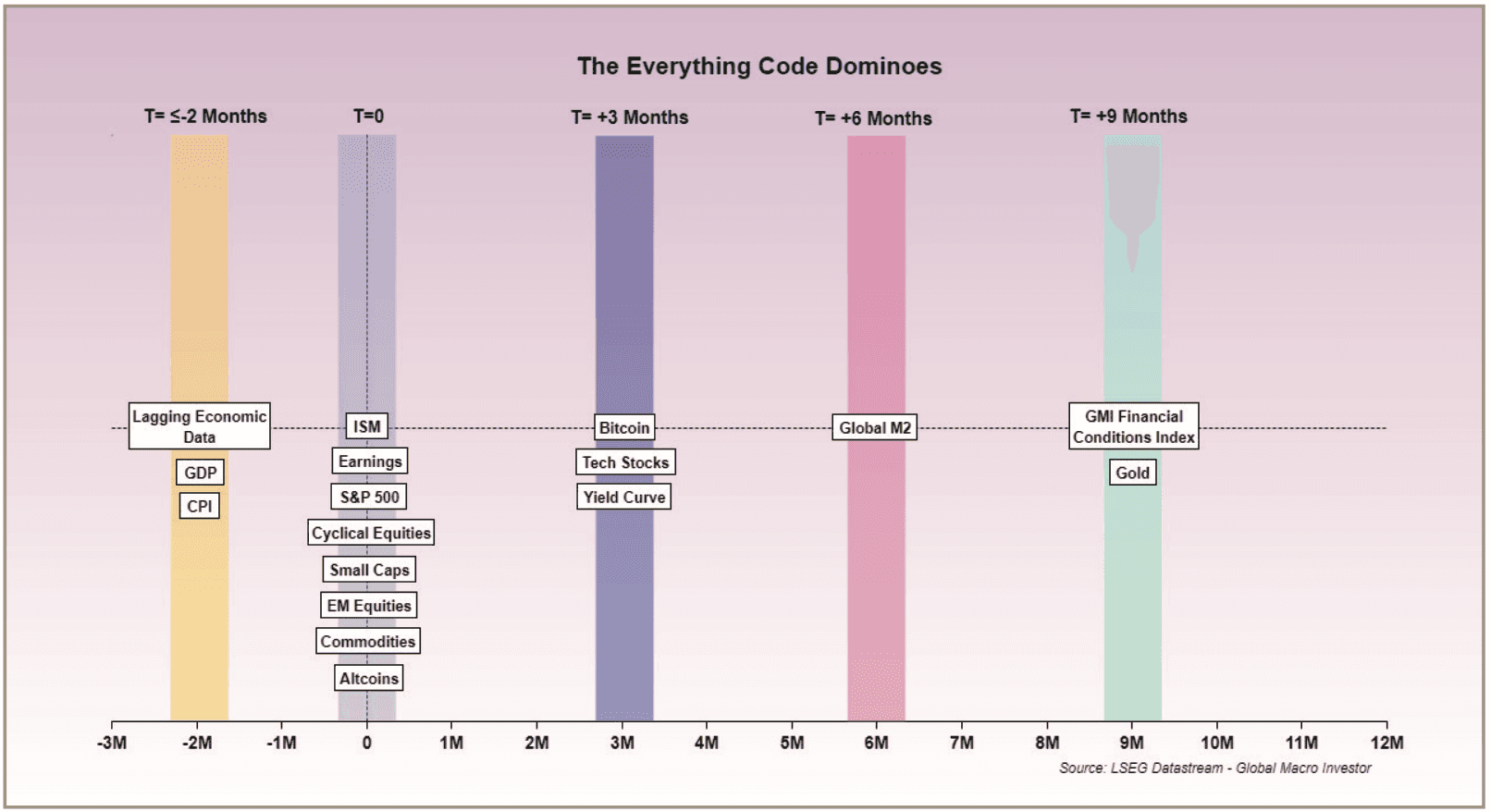
Indicator | Leads/Lags | What It Signals |
|---|---|---|
GMI Financial Conditions (rates, DXY, oil) | Leads | Early signal for liquidity trends |
Global M2 | +3 months | Confirms liquidity expansion or contraction |
Bitcoin, Nasdaq | +6 months | Risk assets respond to liquidity |
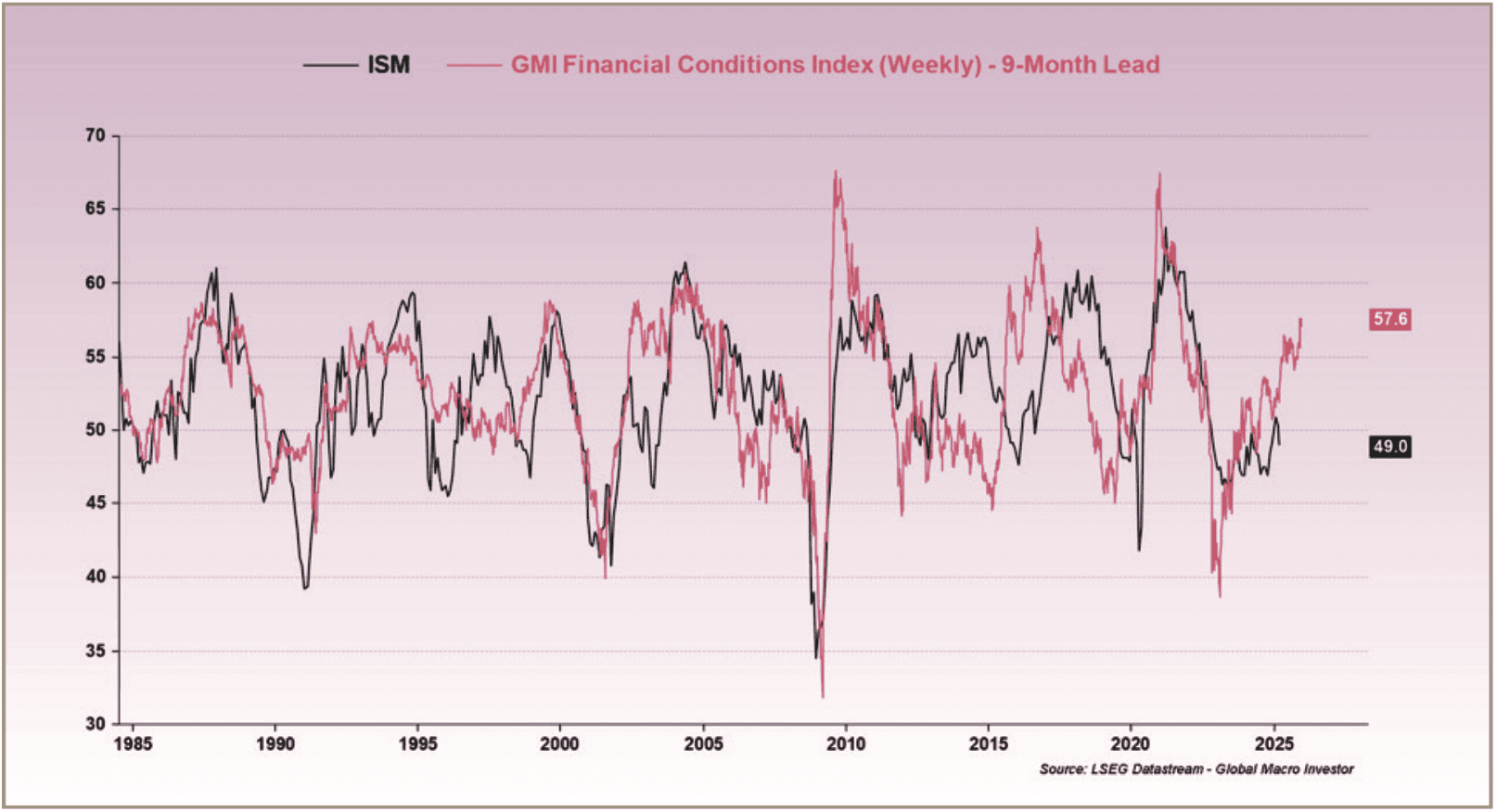
ISM, Earnings, CPI | +9 months | Economic data and headlines catch up |
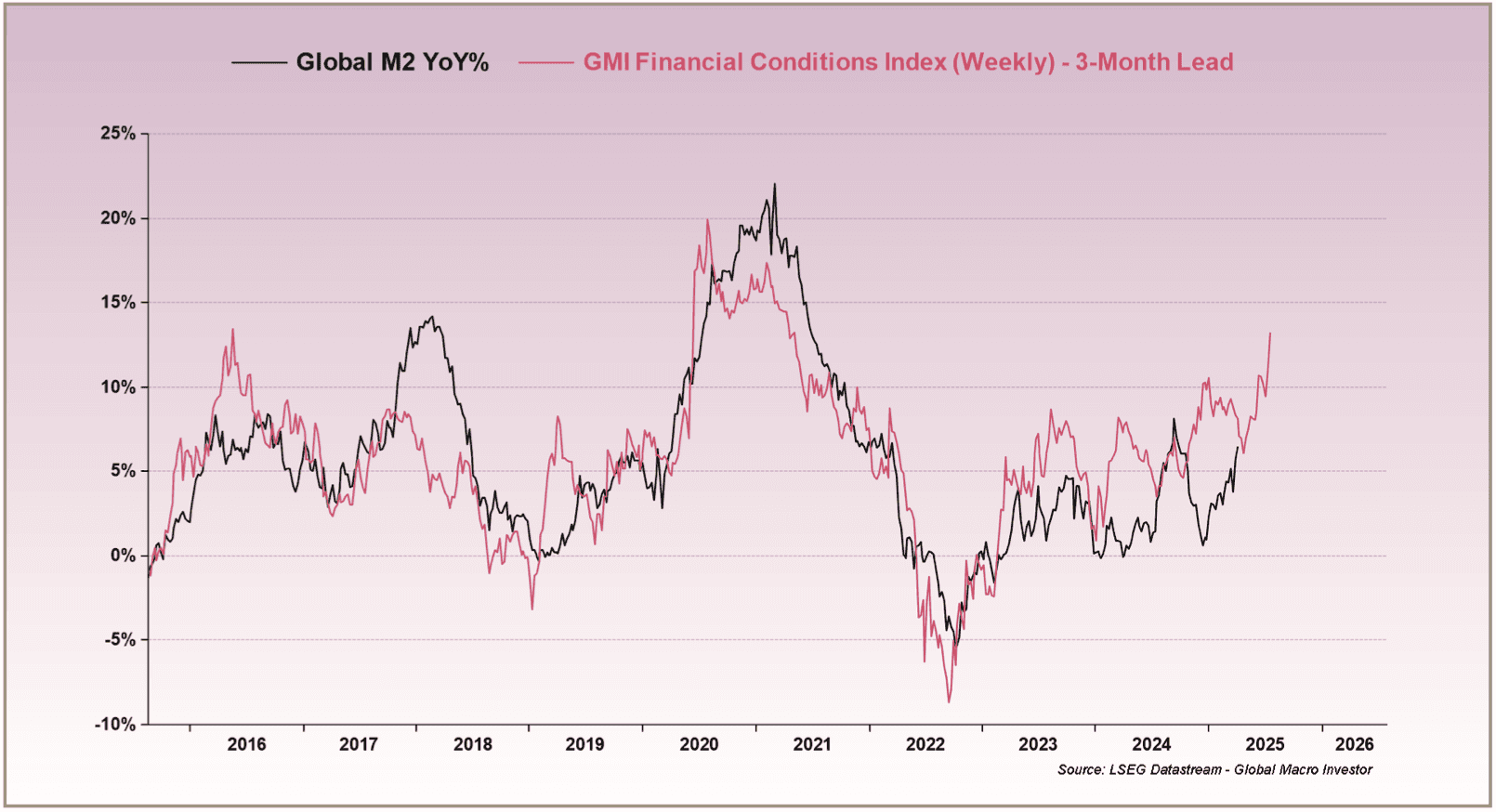
GMI’s data shows this clearly — Financial Conditions lead Global Liquidity by about three months, and that pattern ripples outward through the rest of the system.
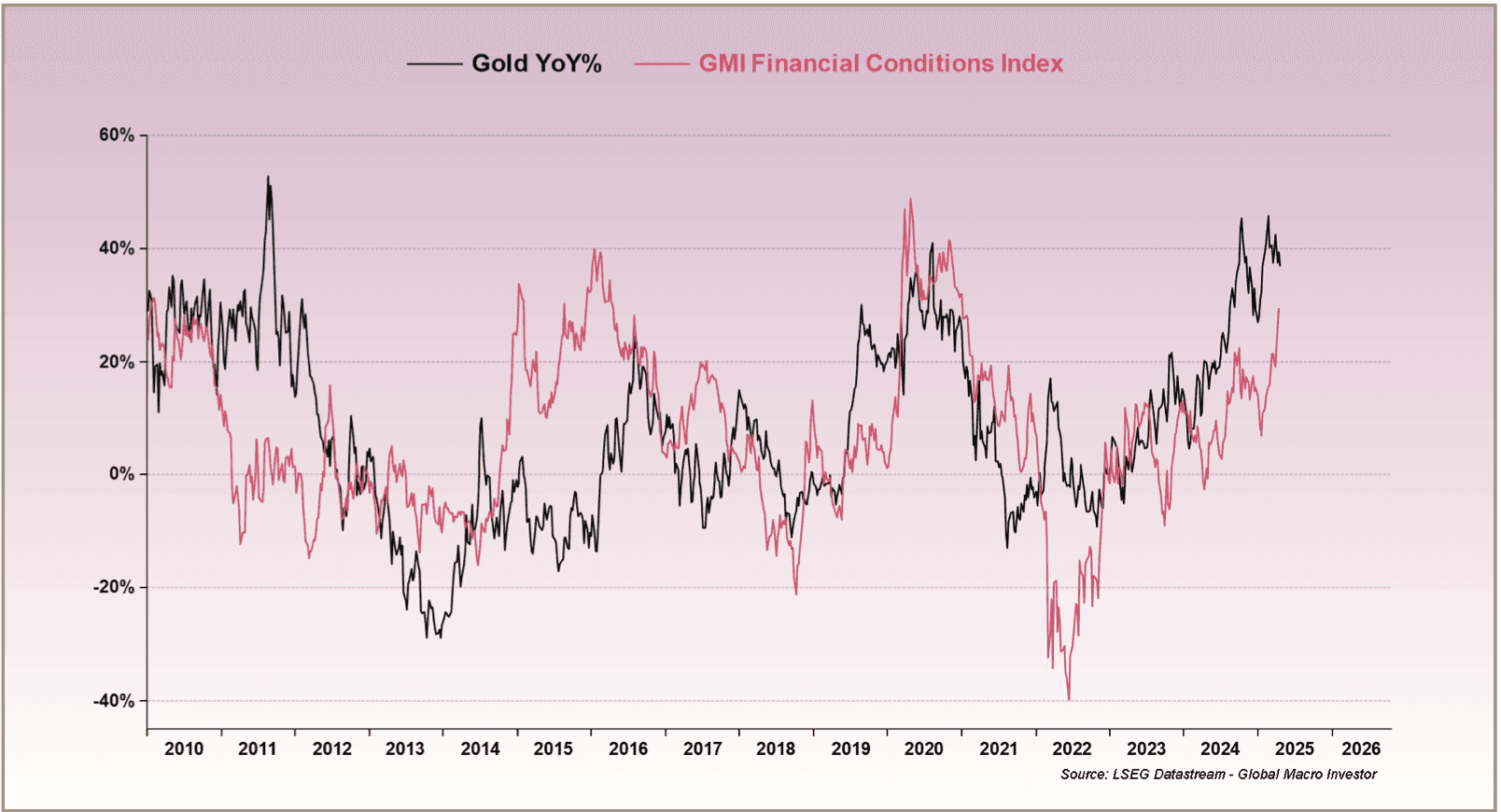
When gold strengthens, it’s usually because financial conditions are easing.
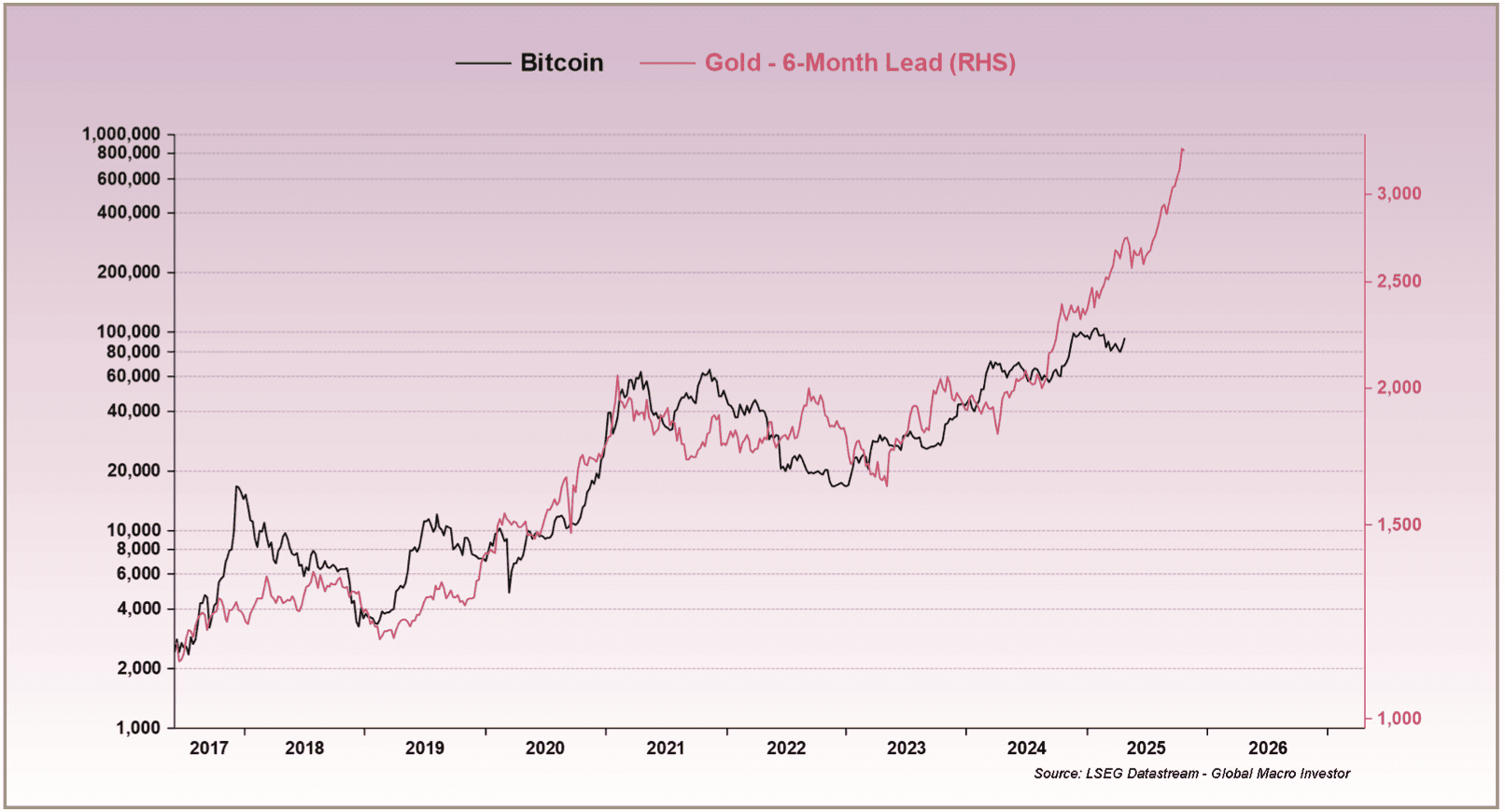
When Bitcoin and tech follow, they’re just reacting to the same liquidity wave.
When *ISM and earnings finally turn, it’s the end of the chain — not the beginning. (*ISM Index = a monthly “vibe check” on U.S. business activity. Above 50 = expansion. Below 50 = slowdown.)
Using It in Practice
This framework changed how I interpret market moves.
When inflation prints high, I check liquidity first.
When earnings dip, I remember they’re nine months behind the story.
Example:
Weaker dollar + lower rates → easier financial conditions.
Easier conditions → more global liquidity (M2).
More liquidity → rising Bitcoin, tech, and eventually, a pickup in ISM.
That’s the domino chain in motion.
And right now (Q3 2025), financial conditions are easing — meaning liquidity is rising — which suggests we’re still mid-cycle in this sequence.
Why It Matters
This isn’t about predicting every move. It’s about understanding the order of operations.
When you can identify which domino just fell, you stop reacting to headlines and start seeing the underlying flow.
Liquidity leads. Narratives follow.
That’s the rhythm of the cycle — the sequence that connects financial conditions, liquidity, and the business cycle itself.